
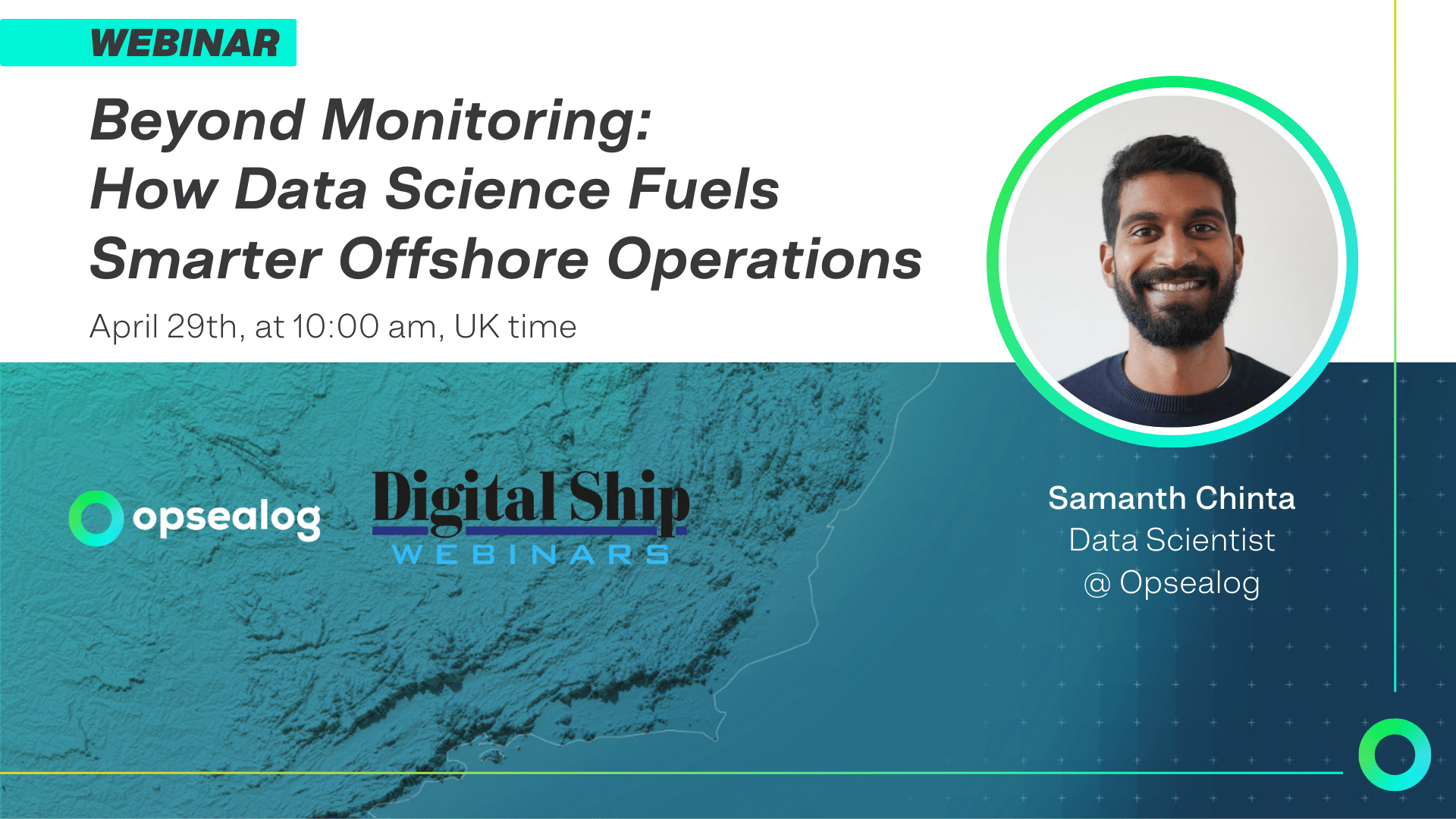
Beyond Monitoring: How Data Science Fuels Smarter Offshore Operations

Apr 30, 2025 | Webinars

Hosted by Digital ship on the 29th of April, this webinar highlighted how data science can best be used to help shipowners and charterers identify ways to improve the efficiency of maritime operations and generate returns.

Improving vessel performance starts with one key element: reliable data. But data from vessels is often fragmented, inconsistent, or slightly incorrect, enough to impact analysis. A faulty flowmeter, an inaccurate AIS signal, or a missing time log can distort entire performance reports. Traditional data validation methods often miss these small but impactful errors.

When data quality is poor, operational inefficiencies increase. Vessel performance monitoring becomes unreliable. Even worse, companies may make decisions based on flawed assumptions, leading to wasted fuel, missed savings, and reduced operational control. Small issues like a delayed status update or a broken sensor can snowball into bigger inefficiencies, especially across large fleets.

Learn how data science is used to improve data quality related to vessel performance and ensure companies efficiently manage their vessels.

With advanced algorithms, AI, and pattern detection, data science helps identify outliers and anomalies that human checks and basic tools often miss. This approach flags suspicious data and recommends corrections or confidence levels, enhancing trust in performance metrics.

Led by Samanth Chinta, Opsealog’s Data Science Lead, the webinar dives into practical use cases, including:

  • Detecting inconsistent fuel consumption patterns
  • Identifying location data mismatches
  • Reducing dependency on manual reporting

🎥 Watch the webinar replay now:


About the speaker

Samanth Chinta has over a decade of experience as an analyst, product manager, and data scientist across multiple industries. At Opsealog, he built the data science roadmap, turning complex maritime data challenges into product-integrated solutions.

linkedin.com/in/chintasamanth

Explore more from Opsealog:


Blog: Can you trust your data collection tool?
Read our white paper on data quality & standardization
Discover our digital solutions

OSJ London 2026: Key Takeaways for the Offshore Support Vessel Industry

The Offshore Support Journal Conference returned to London in February 2026, bringing together shipowners, charterers, class societies, and technology providers to discuss the current state of the OSV market and its outlook. Opsealog was present at the event, with...

Opsealog and ADNOC Logistics & Services renew partnership to expand OSV fuel efficiency and fleet performance program

Renewed contract formalizes a five-year collaboration, scaling digital performance management across one of the world’s largest OSV fleets. Marseille (France) / Abu Dhabi (UAE), 3rd of February 2026 – Opsealog, a provider of data integration and performance management...

Marine Fuel Optimization Starts with Data: Insights from Offshore Operations

Fuel optimization is often treated as an isolated objective. In reality, its success depends on one critical factor: data quality. Without accurate, consistent data, identifying trends or deviations becomes guesswork, which is something few teams can afford. Yet fuel...

Opsealog enters a new phase of development with the support of GO Capital and Sud Mer Invest fund

Marseille (France) – 20 January 2026 – Opsealog, a pioneer in operational and environmental performance solutions for maritime fleets, today announced a major evolution in its corporate structure following a strategic carve-out. The management team has joined forces...

Onboarding Crew to Digital Solutions: 4 Practical Steps for Offshore Operations

The success of any digital initiative at sea or in maritime operations doesn’t depend on the technology — it depends on the people using it. Crews already balance tight schedules, heavy reporting, and demanding operational requirements. A new dashboard or reporting...

How AI and Data Science Build Trust in Offshore Performance

According to Gartner’s 2023 AI in Maritime Operations report (source), organizations that integrate AI and data science in their decision support see efficiency gains of up to 25%. Our paper shows how this applies specifically to offshore supply vessels. Modern...

Why Tracking Engine Running Hours is Key for Shipowners

Engine running hours are often treated as a background metric. Yet for offshore vessels, they carry direct operational and financial consequences. Maintenance frequency, fuel use, emissions, and even asset integrity all connect back to how long engines are in use, and...

2025 Global OSV Market Report

Get the latest data on offshore vessel operations, performance, and environmental impact. Offshore operations continue to evolve. In a market shaped by energy transition, rising efficiency targets, and shifting contractual dynamics, knowing how your vessels perform is...

Charter Party Agreements: Why a Third-Party Solution Matters

Offshore charter party agreements are contracts that govern day-to-day operations, define fuel responsibilities, and can quietly drain budgets and relationships if not managed well. Yet, despite their strategic importance, many offshore charter track contracts are in...

How to Leverage Multiple Data Sources for Smarter Decisions

Offshore vessels are generating more data than ever before. They continuously send information to shore through sensors, automated systems, and manual reports from seafarers. But raw data alone doesn’t improve efficiency. What matters is how that data is processed,...