
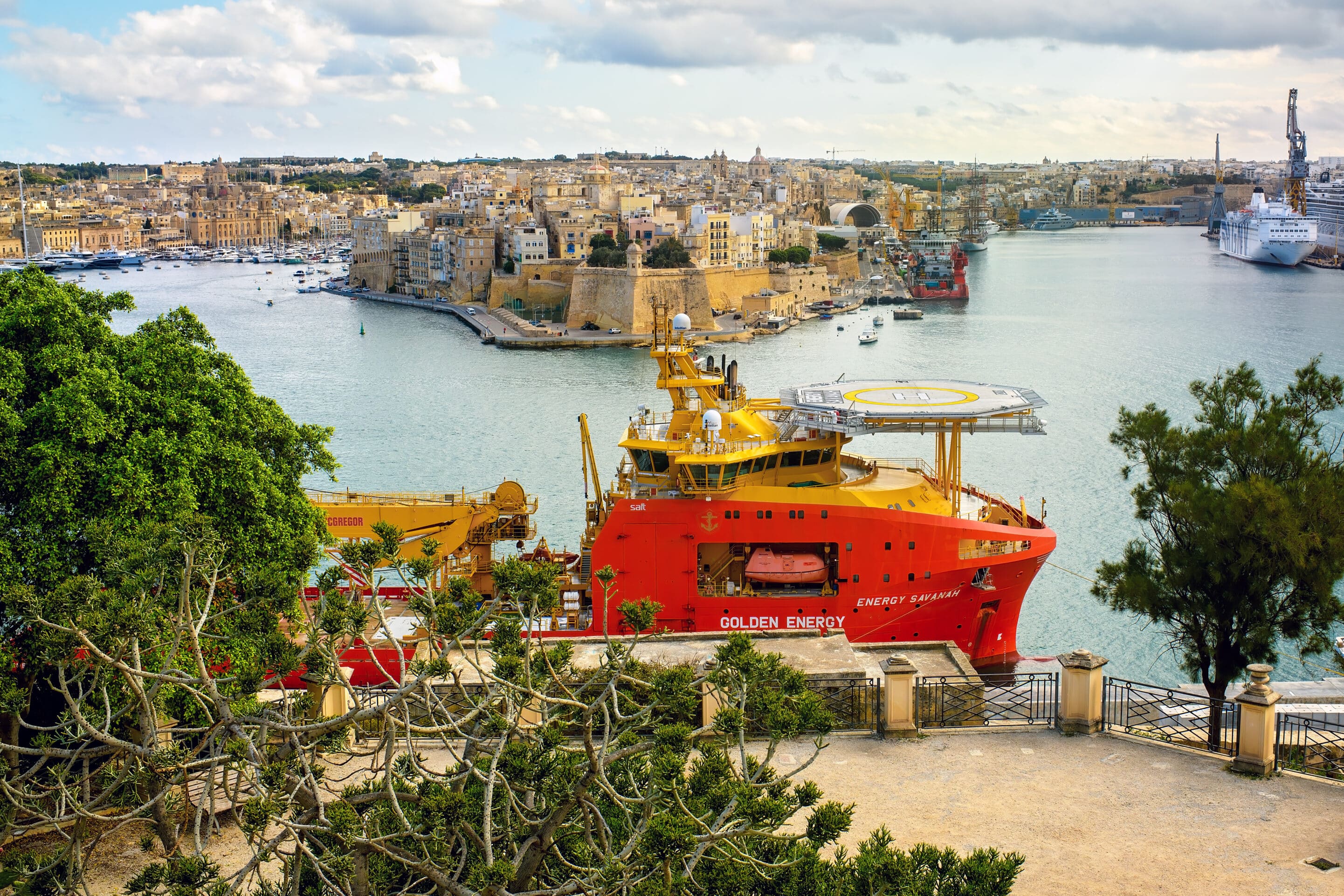
Between 2008 and 2019, offshore supply vessels lost more than 90% of their value. Since then, their value has risen more than tenfold. That swing says a lot about a corner of the maritime industry that most people never see, even though every drilling rig, FPSO and offshore wind farm depends on it. Here are eight marine offshore facts from that world: how these vessels were born, how they hold position at sea, why they now stay in service for 30 years or more, and what the 2026 crisis in the Strait of Hormuz changed for the fleet.
When was the first offshore supply vessel built?
The first purpose-built offshore supply vessel, the Ebb Tide, left a Louisiana yard in 1955 and started work in the Gulf of Mexico in 1956. Until then, rigs got their supplies from converted Navy craft and shrimp trawlers.
Its designer, Alden “Doc” Laborde, put the bridge and accommodation forward and left a long open deck aft, with tanks below for liquid cargo. Look at a PSV delivered last year, and you will recognize the same layout.
The company set up to run the Ebb Tide, Tidewater, went on to become the largest OSV owner in the world by fleet size.
What are the main types of offshore vessels?
Offshore vessels are classed by the job they do, and the two largest families, platform supply vessels (PSVs) and anchor handling tug supply vessels (AHTS), add up to around 3,200 ships in service worldwide. A common question is the difference between a PSV and an OSV: OSV is the umbrella term for every offshore support vessel, and the PSV is one type within that family. Many vessels combine several roles, so the lines between types often blur.
- PSVs run the supply chain between shore bases and installations. Cement, barite and bentonite travel as dry bulk in pneumatic tanks. Liquid mud, drill water, methanol and fuel sit in separate tanks below deck. Pipes, containers and equipment ride on the open aft deck.
- AHTS add high power, large winches and a stern roller. They tow drilling rigs, run and recover anchors and mooring chains, and still carry supplies between jobs. The strongest of them, Island Victory, holds the world record with 477 tonnes of bollard pull, and once held 440 tonnes of continuous pull on a single anchor off Norway, a job that normally takes two vessels.
- Multipurpose supply vessels (MPSVs) and IMR vessels support subsea work with cranes, ROVs and extra accommodation, and some carry walk to work gangways.
- Crew boats and fast supply intervention vessels (FSIVs) move personnel and urgent cargo at speed.
- Emergency response and rescue vessels (ERRVs) stand by near installations, ready to recover people from the water.
- Crew transfer vessels (CTVs) and service operation vessels (SOVs) do this work for offshore wind farms.
Why are ship hulls painted red, and offshore vessels orange?
Bright orange and red stand out against a grey sea and sky, so rescue teams and helicopter crews can spot a vessel fast in poor visibility. Some owners turn color into a signature: Eidesvik paints its entire fleet orange, and most of its vessels carry names starting with Viking.
Below the waterline, the red has a different origin. Early antifouling paints were made with copper, which turned ship bottoms red, and the tradition stuck even though modern coatings come in any color.
That paint does more than look good. Barnacles and algae on the hull slow a vessel down and make it burn more fuel, which is why hull condition is one of the first things to check when consumption starts to drift.
How does a ship stay in place without an anchor?
Most modern PSVs use dynamic positioning (DP): a computer compares the vessel’s actual position with its target and drives the thrusters and propellers to hold position and heading against wind, waves and current. The vessel stays put with no anchor and no mooring lines.
The idea dates back to 1961. Shell fitted a small core drilling ship, the Eureka, with an automatic controller and a taut wire, and it became the first true DP vessel. Anchored coring ships of its size needed a day or two to drill a single hole in 60 to 90 meters of water. The Eureka drilled up to nine core holes in a day, in water as deep as 1,200 meters.
To know exactly where it is, a DP vessel combines position reference systems that work on different principles: satellite positioning, lasers aimed at reflectors on the platform, microwave, taut wire or underwater acoustics. If one source drifts, another takes over.
DP is used whenever anchoring is impossible or unsafe: alongside a platform during cargo operations, above subsea wells and pipelines that an anchor could damage, in deep water, and during ROV or walk-to-work operations. Redundancy then decides what a vessel is allowed to do. Every vessel entering the 500m zone follows much stricter rules than open-water DP, as the area can be dangerous: a collision could happen, which can cause catastrophic damage, pollution, or loss of life.
Why are offshore vessels working longer than ever?
The average PSV and AHTS is now more than 20 years old, and owners keep vessels at work for 30 years or more because new ones rarely make financial sense.
The reason goes back to the last crash. Owners ordered aggressively through the 2000s boom, and by 2017 the fleet had swelled to nearly 5,000 vessels. The oil price collapse of 2014 left that fleet chasing far less work. By late 2019, PSV and AHTS values had lost more than 90% of their peak.
The recovery since has been just as sharp. Vessel values have risen more than tenfold from their 2019 low, and Westwood expects marketed utilization to pass 79% in 2027.
Owners remember the crash, though. Speaking at OSJ London in February 2026, Tidewater’s CEO Quintin Kneen described OSVs as 25-year assets and a newbuild as a 25-year bet. His company depreciates vessels over 25 years and says they can keep working for 30 to 35 years with serious upgrades. One PSV in West Africa shows what that looks like: built in 2008 and nearly scrapped in 2017, it now works on a term charter.
Watch the interview: Speaking at OSJ London in February 2026, Tidewater’s CEO Quintin Kneen described OSVs as 25-year assets / https://vimeo.com/1166726050?fl=pl&fe=cm
Why does the Strait of Hormuz matter for offshore vessels?
In early 2026, the Middle East hosted around 1,440 OSVs, roughly 19% of the global fleet, so the conflict that disrupted the Strait of Hormuz hit the offshore market directly. Across all offshore asset classes, about one vessel in five was based in a region where activity had effectively stopped.
War risk insurance for offshore energy assets was withdrawn or repriced. In Qatar, offshore work paused from mid-March after damage to the Ras Laffan LNG facility and drilling at North Field West was pushed back from the second half of 2026 to the second half of 2027.
An April ceasefire let activity restart gradually, though fixing volumes stayed below their historical average. By October, preliminary estimates put oil flows through the strait at around 82% of pre-war levels.
Behind those figures are crews. Since the conflict began on 28 February 2026, the IMO has confirmed more than 130 incidents involving merchant ships across the region, and at least 25 seafarers have lost their lives. At the height of the crisis, around 20,000 seafarers were stranded on some 2,000 ships in the Gulf, facing dwindling supplies, fatigue and severe psychological stress. As the IMO Secretary-General has put it, seafarers must not be targets.
The crisis is also redrawing the map. Middle Eastern owners are looking for work in other regions: Astro Offshore, for example, has expanded into West Africa through PSV and subsea vessel acquisitions. Analysts expect more offshore activity in the Mediterranean, West Africa, Australia and the North Sea in the coming years, which could tighten vessel supply there.
Why is working off West Africa so different from the North Sea?
The North Sea is famous for its storms, while West Africa offers calmer weather and a different set of challenges: long ocean swell, long distances, security and connectivity.
Off northern Angola, the 100-year design wave is 6 to 7 meters, about a fifth of the North Sea or Gulf of Mexico figure. The catch is swell. Storms in the South Atlantic send long-period swells, with peaks around 22 seconds, all the way to the Gulf of Guinea. They are strongest from June to September and can set floating units and vessels moving on a calm, sunny day, which makes cargo transfers harder.
Security is a constant consideration. The International Maritime Bureau still urges caution in the Gulf of Guinea, so operators plan routes, port calls, and crew transfers carefully, and many regional fleets include dedicated security vessels.
Connectivity has changed fast. Owners such as Solstad, which operates in Africa, now run Starlink as their main link with VSAT as a backup, so vessel data reaches shore teams the same day.
In Norway, the pressure sits on emissions. Equinor requires energy storage on supply vessels under a long-term contract, and bases such as Dusavik, Mongstad and Kristiansund supply shore power at the quay.
How much fuel can an offshore vessel save?
An offshore supply vessel burns between 1 and 8 m³ of fuel a day, depending on its size and what it is doing. In most charters, the charterer pays for that fuel, which is why West African operators were among the first to track it closely.
Our guide to fuel consumption monitoring on offshore supply vessels explains how to measure that consumption and the CO₂ behind it.
Opsealog’s first fuel efficiency project, with Total E&P Angola in 2017, cut consumption by 11.5% across a fleet of 15 vessels. In Ghana, a year of structured monitoring on Tullow Ghana’s AHTS MV Flat Confidence saved 732.6 m³ of fuel and 1,984 tonnes of CO₂. Off Angola, a mixed fleet of 24 vessels saved 1,108 m³ in six months. These results came from changes in daily practice, guided by data, with no new equipment on board. Find the full method in our white paper, The Conversion Gap.
Seventy years after the Ebb Tide, offshore vessels look much the same from the quay. The people on board have had to adapt to almost everything else: weather conditions, rough seas, security risks in the Gulf of Guinea, conflict around the Strait of Hormuz, new technologies…and rotations that keep them away from their families for weeks at a time.
The fuel in our cars, the gas that heats our homes, and a growing share of the electricity from offshore wind all depend on their work. Most people will never see an offshore supply vessel, yet every one of us relies on the crews who sail them!