
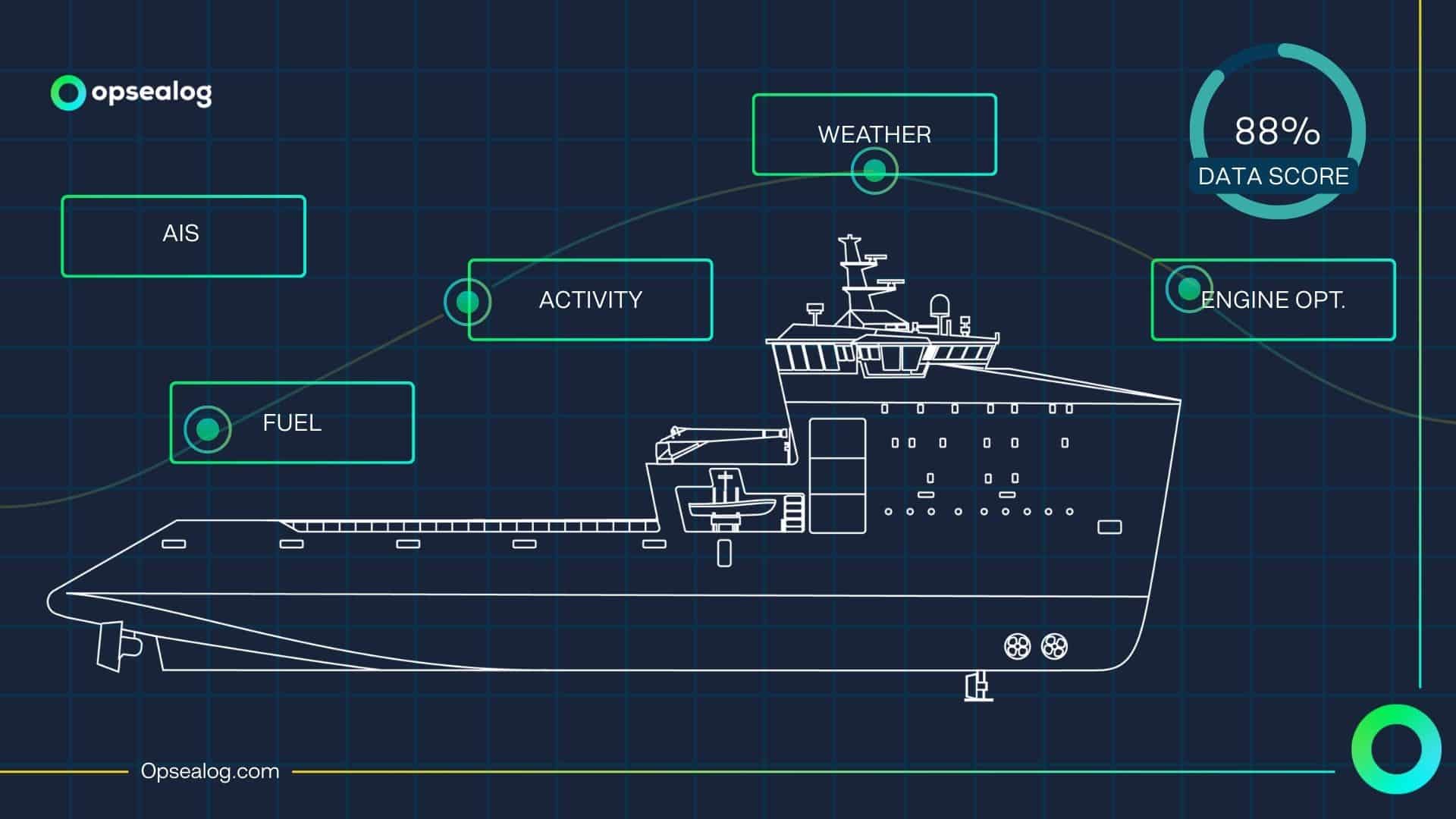
Offshore fleet management runs on operational data collected across multiple sources simultaneously: vessel logs, AIS feeds, onboard sensors, and engine management systems. However, consolidating these sources into a single reliable picture requires structure, validation, and the right analytical layer to transform this data into action.
At Opsealog, we have worked with more than 1,000 offshore vessels over the past decade. The pattern is consistent: the fleets that improve performance fastest are those that build processes to act on their data with confidence. This article explains what that requires in practice, and where artificial intelligence fits into that equation.
The data gap that costs fleets more than fuel
A vessel’s bridge logbook records 22.5 tons of fuel consumed. An onboard sensor reads 23.4 tons. Meanwhile, AIS shows a 10-hour transit with a 1.5-hour gap in positioning data. Three sources, three answers. For the fleet manager calculating emissions for compliance, or the charterer reconciling contract performance, none of these figures stand on their own.
This is not an unusual situation. It plays out across offshore fleets every day. As a result, the consequences go well beyond administrative inconvenience. Miscalculated fuel budgets, disputed contract figures, and failed emissions audits are the measurable outcomes. The underlying issue is not that offshore vessels lack data. Modern vessels generate terabytes of operational information daily. The issue is that much of that data, without structured validation, cannot be trusted as a basis for decisions.
Gartner estimates that poor data quality costs organizations an average of USD 12.9 million annually. In maritime, the impact is operational: hours spent reconciling conflicting figures instead of improving performance, and decisions made on numbers that have never been cross-checked.
[ii] (Gartner, Data Quality Market Guide, 2022)
Why most AI projects fail without a solid data management foundation
Teams across the offshore industry discuss artificial intelligence frequently, yet deliver results in very few cases. The reason is consistent: organizations launch AI projects before their data foundation is ready. They build models on inputs teams have not validated, train algorithms on figures that mix reliable and unreliable sources, and deploy outputs into operations nobody can verify. The technology is sound. The conditions are not.
At Opsealog, therefore, offshore fleet data management starts one step before any model runs. We collect and compare two data streams: reported data from daily vessel logs, and measured data from AIS feeds, fuel flow meters, and engine management systems. Most platforms treat these separately. Using both, however, is what makes it possible to train models against ground truth rather than assumptions.
“Unlike many competitors, we can train models with labeled truth, because we collect both reported and measured data.” Samanth Chinta, Data Scientist, Opsealog
Our deep learning model reads vessel movement data as a continuous time series and labels each minute by likely activity: transit, standby, port call, or field operation. It then matches these AI-generated labels against what the crew declared in their daily report. When the two diverge beyond a defined threshold, the system flags the report and assigns a confidence score between 0 and 100%. Consequently, analysts review low-scoring reports before they enter any downstream model or compliance filing.
In practice, this creates a quality assurance layer between raw vessel data and the performance models above it. It does not replace the crew or the reporting process. Instead, it provides the verification layer that makes those reports usable for decisions that matter.
Offshore vessel performance modeling requires more than data science
Data science without operational context produces technically correct outputs that crews and fleet managers cannot act on. The offshore environment is specific: rotating crews, variable operating conditions, diverse vessel types, and practices that differ by region, client, and configuration. For example, a model calibrated on deep-sea tanker behavior will generate flawed recommendations for an AHTS operating in field conditions.
One case illustrates this directly. Our analysis of an AHTS vessel challenged a common crew assumption: that transiting at 4 knots minimizes fuel burn. At low speeds, the generator runs at low load and produces less power per liter consumed. By contrast, the same vessel transiting at 7 to 8 knots with a single generator at a higher load delivered better fuel efficiency per nautical mile. Engine wear is reduced, and fuel cost per nautical mile drops.
This finding required both the infrastructure to capture and validate high-frequency engine and position data, and the maritime expertise to frame the right question in the first place. Without both, the insight does not surface.
From offshore fleet data management to operational decisions
Fleet managers and charterers need performance KPIs they can present to the board, defend in an audit, and use in conversations about contract performance. Therefore, every figure must be traceable: validated across multiple sources, versioned as models improve, and qualified with a confidence rating.
This is what separates a decision-support platform built on validated data from a reporting tool that relies on the daily report at face value. Furthermore, the question shifts from whether the numbers are correct to what actions they point toward.
“We know how much data is available. Give us the power to act on it.” Damien Bertin, Business Director, Opsealog
For shipowners, this means vessel-level benchmarks grounded in comparable assets. For charterers, it means contract performance data ready to use without prior reconciliation. For both, it means an emissions reporting process built for the scrutiny that IMO and EU regulatory requirements will demand.
Key Takeways
| 1 | Without structured cross-validation, data cannot reliably support compliance, budgeting, or optimization decisions. |
| 2 | Artificial intelligence should be used to enhance expertise, not replace it. |
| 3 | Fuel optimization at the vessel level requires both clean data and operational field knowledge. |
| 4 | Shipowners and charterers with a solid data foundation today will hold a strong competitive advantage tomorrow. |
Learn more about our latest technical paper: How AI & Data Science build trust in offshore performance: